
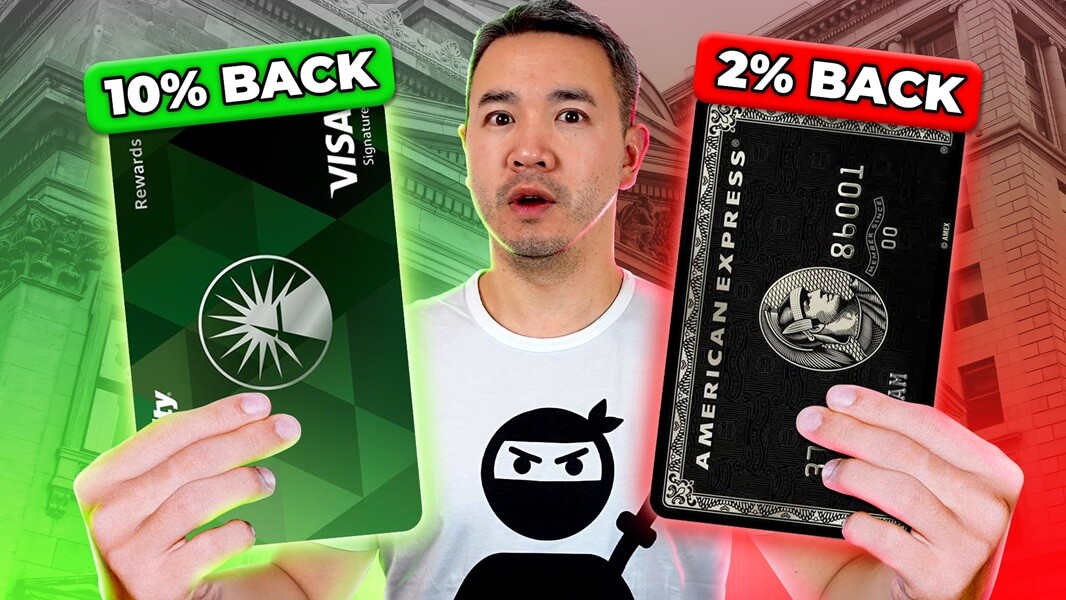
So why should you care about a “boring” 2% cash back credit card from Fidelity? After all, the market is filled with 2x cards like the Citi Double Cash or Capital One Venture X. But here’s why the Fidelity Rewards Visa Signature credit card is much more than that.
The Fidelity Rewards Visa Signature card not only gives you perks and benefits you almost never see from a no fee credit card, but it acts as a “stealth wealth” builder, connecting the gap between spending and investing. That 2% back can easily grow to 3%, 7%, or even 10% back if you know how to use it right.
Quietly, it has become the most powerful wealth-building tool you can have in your wallet. In this post, I’ll go over why this “boring” card should belong in your wallet, how it stacks up against the more well-known 2% cards, and what you need to do in order to turn this card into a wealth-building machine.
This post may contain affiliate links, meaning I get a commission at no cost to you if you decide to make a purchase through my links. Visit this page for more information. The content on this page is accurate as of the posting date; however, some of the offers mentioned may have expired.
More Than A 2% Card
On paper, the Fidelity credit card looks like a typical cash back card. It has no annual fee and offers an unlimited 2% cash back on every single purchase. There are no categories to track, no caps to hit, and no “activation” buttons to click every three months. But here’s why it’s punching way above its weight class.
First is the “Visa Signature” tag. Usually, cards with no annual fee don’t have this designation, so they’re stripped of any travel protection. Apparently, Fidelity didn’t get that memo because this card comes with a $100 TSA PreCheck or Global Entry credit, a perk almost exclusively reserved for “premium” cards that charge $95 to $395 a year.
It also features no foreign transaction fees. If you’ve ever used a Citi Double Cash card abroad, then you got slapped with a 3% fee. Your “2% back” just turned into a 1% loss. Fidelity is a true global “catch-all” card that you can take from a Boston coffee shop to a Parisian bistro without a second thought.
Then there’s the recent improvement update. For years, the biggest gripe with this card was the $25 redemption minimum. You had to wait until you spent $1,250 before you could touch your rewards. Fidelity finally listened to the crowd and scrapped the minimum. You can now set up automatic redemptions that sweep your rewards into your Fidelity account at the end of every cycle, regardless of the amount. It’s the definition of “set it and forget it.”
Fidelity vs. The Competition
To understand why this is the best 2% catch-all card, we have to look at three popular competitors.
First up is the Citi Double Cash. It’s the classic 2% card, but it’s crippled by that 3% foreign transaction fee. It also requires a “two-step” process – you get 1% when you buy and 1% when you pay it off. Fidelity is 2% out of the gate. While Citi allows you to transfer points to airlines if you have their premium card, it doesn’t have the built-in investment sweep that Fidelity pioneered.
Second is the Capital One Venture X. I have this card, and it’s a fantastic card, but it comes with a $395 annual fee. Yes, you do get a bunch of great benefits like lounge access and 2x miles, but you’re handcuffed to a travel portal to justify the cost.
For the minimalist who wants zero overhead and zero travel portal games, Fidelity offers the same 2x catch-all rate for a price tag of exactly zero dollars.
Then, there’s the much-hyped Robinhood Gold Card, which offers 3% back. It sounds like a Fidelity killer, but there’s a catch. You have to pay $50 a year for Robinhood Gold to even get the card. Beyond that, many investors still have trust issues with a fintech start-up. How long is the 3% sustainable before they nerf it? It’s a valid concern. Who knows at this point? But I know I trust a legacy titan like Fidelity, which manages trillions of dollars, a whole lot more.
The Compounding Multiplier
The real reason this card is taking over isn’t the 2%, it’s what happens after the 2% hits your account. When you redeem your rewards into a Fidelity Brokerage, IRA, or Cash Management account, you aren’t just getting cash; you’re getting investment fuel.
Think about the math of a “Points Maximalist.” They might get 1.5 to 2 cents per point by booking a flight. That’s great for a vacation today. But if you take that 2% and funnel it into a zero-fee index fund like Fidelity’s Total Market Index, ticker symbol FZROX, you’re letting that money capture the historical 8 to 10% return of the stock market.
Here’s how it looks like when you play the “long game” with this card. If you spend $3,000 a month on this card, you’re earning $60 in cash back. Over 20 years, you’ll earn a total of $14,400. But if that $60 is invested monthly and grows at an average rate of 10%, that balance balloons to $45,562.
Your “2% card” effectively became a 6.33% card when measured against your original spend. If you’re 25 years old and you do this until retirement, that simple 2% back can turn into a six-figure addition to your nest egg, to $379,445, just from your daily expenses.
Because your cash back grew so significantly in the market, the $379,445 you ended up with is equivalent to an effective return of 26.35% on every dollar you spent during those four decades.
This is the psychological edge. Most of us are horrible at saving, living paycheck-to-paycheck. According to a recent study by Goldman Sachs, 42% of younger Americans, which include Gen Z, millennials, and Gen X, have no money left over after covering their basic expenses. This card forces you into a position of success by automating the one thing we all forget to do: paying our future selves first.
Fidelity Card Respects Your Time
I’m not going to lie, I love premium credit cards and own many of them, including the American Express Platinum, Chase Sapphire Reserve, and Capital One Venture X. Maryna and I have traveled to over 140 countries, so I get why these cards are loved by many.
But the brilliance of the Fidelity Visa card is that it respects your time. In the personal finance world, we talk a lot about “ROI“, the Return on Investment, but we rarely talk about “ROT“, the Return on Time. The hours you spend tracking categories, activating offers, and managing multiple logins could be spent earning more money at your job, starting a side hustle, or simply enjoying your life. The Fidelity card gives you 90% of the benefits of a perfectly optimized wallet with 0% of the effort.
By the time you finish your first year with this card, you won’t just have a list of “points and miles” that you’re worried about expiring, you’ll have an investment account with hundreds or thousands of dollars in it, already working for you in the background. It turns the disposable nature of credit card rewards into a permanent asset.
If you’re ready to stop “playing the game” and start building a legacy, the Fidelity card is the most efficient way to turn your grocery bill into a retirement fund. It’s not flashy, it’s not prestigious, and it won’t make a heavy thud on a marble table, but your bank account will thank you in twenty years.

I agree with you, John. I’ve had this card for years and it’s the one I use most often. (Last year’s rewards topped $700.) A little-known extra benefit is that the cash back percentage increases up to 3% if Fidelity manages your money. Wealth Management Clients with $250K to $1 million in eligible assets get 2-1/4% cash back, $1 to $2 million get 2-1/2%, and $2 million plus get the 3% maximum cash back. Yes, you pay a fee for them to manage your money, so it’s not all gravy. But for old guys like me who no longer want the stress and anxiety of managing my assets myself …