

When it comes to saving money, the process is typically the same: open a savings account and earn a little bit of interest on your money over time. Symphony is trying to flip that idea on its head.
Instead of just earning cash interest, Symphony lets you choose how your 5.00% APY is delivered: cash, points, or a mix of both.
The platform combines a high-yield cash account with a travel rewards program, allowing users to earn interest, points, or a mix of both. It’s one of the most unique savings products I’ve seen in recent years, especially for those of us who enjoy traveling and maximizing rewards.
In this review, I’ll take a look at how Symphony works, what makes it different from a traditional savings account, and whether it’s worth considering for your cash savings.
This post may contain affiliate links, meaning I get a commission at no cost to you if you decide to make a purchase through my links. Visit this page for more information. The content on this page is accurate as of the posting date; however, some of the offers mentioned may have expired.
Download App: For a limited time, Symphony is offering readers of this site an extra 7,500 bonus points on top of the 100,000-point sign-up bonus for qualifying deposits (Android version coming soon).
What Is Symphony?
Symphony.io, or Symphony, is a fintech app that allows users to earn a fixed 5.00% APY, accumulate rewards points, or choose a mix of both on their cash.
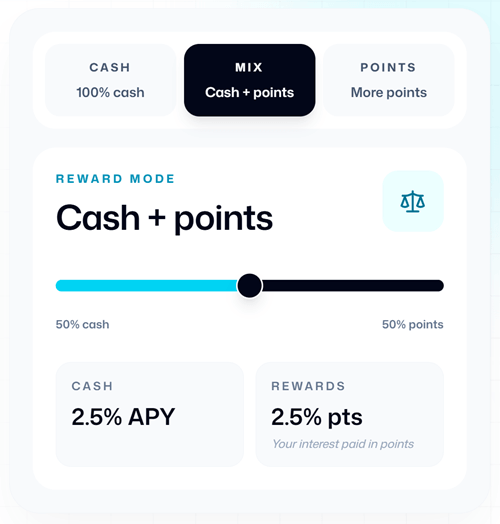
As a saver, but also a miles and points junkie, I love this concept. Why should credit card companies be the only ones rewarding people? And instead of earning points by spending thousands of dollars, Symphony lets users earn rewards simply by saving money.
Users can connect their bank account, deposit funds, and choose how they want their earnings distributed. You can maximize cash interest, maximize points, or create a custom blend of both depending on your goals.
This gives travelers and points enthusiasts another option to earn rewards.
How Symphony Works
Symphony just launched in June 2026 on the App Store and will soon be available on Android. Getting started with Symphony is straightforward.
And right now, Symphony is offering readers of this site an extra 7,500 bonus points on top of the 100,000-point sign-up bonus for qualifying deposits they’re running for a limited time, when they sign up by using this download link or clicking the button below:
The 100k welcome bonus is based on both the total deposit amount you transfer over in the first 30 days of account opening and the amount of recurring deposits you make monthly:
| Total Deposit Amount | Bonus Points |
| $1,000 | 1,500 |
| $5,000 | 10,000 |
| $10,000 | 25,000 |
| $20,000 | 60,000 |
| $25,000 | 80,000 |
| Monthly Deposits | Bonus Points |
| $100+/mo | 2,000 |
| $500+/mo | 10,000 |
| $1,000/mo | 25,000 |
Readers of this site also get up to an additional 7,500 points based on their initial deposit amount:
| Initial Deposit | Bonus Points |
| $1,000 | 750 |
| $5,000 | 3,000 |
| $15,000 | 7,500 |
All three bonuses above (total deposit bonus, recurring deposit bonus, and the exclusive bonus) gradually pays out over the following 12 months rather than arriving at once.
After creating an account and linking your bank through Plaid, you transfer funds into your Symphony account. Once your money is deposited, it begins earning rewards automatically based on your choice of:
- 100% cash interest (currently at 5.00% APY)
- 100% points
- Any combination of cash and points in between
For example, you might choose to receive 50% of your earnings as cash interest and the other 50% as rewards points. Here’s what that looks like after one year if you make an initial $10,000 deposit and $1,000 in monthly contributions:

In a year, you’d earned $386 in interest and 38,629 in points (and that’s not counting the 100k welcome bonus). Transferring 34,000 of those points to one of Symphony’s upcoming airline partners like Virgin Atlantic is enough for a roundtrip flight to Europe!

Or, if you’re focused on an upcoming trip, you can shift your earnings heavily toward points. You can change your mix at any time.
Another feature I like is the flexibility. There are no lock-up periods, no minimum balances, and users can withdraw funds when needed rather than committing money to a CD or other fixed-term product.
Comparisons
Symphony vs Savings Accounts
The biggest difference between Symphony and a traditional or high-yield savings account is that Symphony isn’t trying to compete solely on interest rates. Most savings accounts offer one thing: cash yield. You deposit money, earn interest, and that’s the end of the story.
Symphony adds a rewards layer on top.
Instead of choosing between earning cash or travel rewards, you can effectively decide how you want your returns delivered. If you’re someone who values airline miles, hotel stays, or travel experiences more than raw cash, that flexibility could be appealing.
Another difference is the psychology behind it. Traditional savings accounts are designed to help you preserve and grow cash. Symphony tries to make saving feel more rewarding by attaching tangible perks to the process.
In a way, it’s borrowing some of the excitement from rewards credit cards while encouraging the opposite behavior – saving instead of spending.
Symphony vs. Bask Bank
The closest competitor to what Symphony does is Bask Bank.
If you’re a points and miles geek like me, you’ve probably heard of Bask Bank’s Mileage Savings Account. Instead of paying traditional interest, Bask allows customers to earn American Airlines AAdvantage® miles based on their account balance.
The two platforms seem very similar because both reward saving rather than spending. However, there are some key differences.
The biggest advantage Symphony has over Bask Bank is flexibility. With Bask, you can earn miles (and only AA miles) and not interest, because of the account type you open. Symphony allows you to blend the two, and you can transfer points to many different airline programs as they onboard their partners, including:
- Air Canada (Aeroplan)
- Alaska Airlines (Atmos)
- American Airlines (AAdvantage)
- British Airways (Avios)
- JetBlue (TrueBlue)
- United Airlines (MileagePlus)
- Virgin Atlantic (Flying Club)
On the other hand, Bask Bank is an actual bank so it’s FDIC insured. For many savers, that added layer of protection may outweigh the additional flexibility offered by Symphony.
Which one is better will ultimately depend on what matters most to you. If FDIC insurance and simplicity are your top priorities, Bask Bank may be the stronger choice. If you value flexibility and like the idea of earning a combination of points and cash, Symphony may be worth a closer look.
Is Symphony a Bank Account?
While Symphony functions similarly to a savings product, it’s not a bank account so it doesn’t offer FDIC protection like a bank. However, it does offer multiple layers of protection via:
- SIPC protection through their licensed custody partners
- Supplemental excess coverage via Lloyd’s of London
- DeFi-deployment coverage via Nexus Mutual for smart-contract and protocol risks
- Dedicated reserve fund
How Does It Offer 5.00% APY?
Symphony generates yield through a mix of strategies that include U.S. Government Treasury-related holdings, institutional credit, and other lending-based investments:
- Tokenised Treasury Bills = Short-term U.S. Treasury Bill exposure tokenised on-chain, with custody through Alpaca Securities.
- Collateralized Loan Obligations = Floating-rate structured credit through Janus Henderson CLO ETFs (beginning with AAA-rated JAAA).
- Private Credit = Short-duration, asset-based finance across fintech-originated private credit rails.
- Overcollateralized Lending = Collateral-backed lending markets selected for public liquidity, conservative utilization, active monitoring, and technical risk coverage.
Their goal is to generate yield through diversified institutional lending strategies in order to reduce concentration risk.
Pros and Cons
Pros
Earn rewards without spending money
Most travel rewards programs require you to spend money on a credit card. Symphony allows you to earn points simply by holding cash.
Flexible earnings structure
I like that users can choose between cash interest, points, or a combination of both. That flexibility allows you to customize your rewards based on your financial goals.
Competitive yield potential
Symphony offers a fixed 5.00% APY, which is currently the best rate compared to the best high-yield savings accounts.
No lock-up periods
Unlike CDs or other fixed-term investments, you can access your funds when needed without committing your money for months or years.
Appealing for travel enthusiasts
If you’re already interested in points and miles, Symphony offers another way to accumulate rewards without opening additional credit cards or increasing your spending.
Cons
Not FDIC insured
This will likely be the biggest drawback for some savers. Symphony is not a traditional bank account, so it doesn’t offer the same FDIC protections found at most banks.
Limited operating history
As a newer platform, Symphony doesn’t yet have the long track record that many savers prefer when deciding where to keep their money.
Points valuations can vary
While points can provide excellent value when redeemed strategically, they don’t offer the same certainty as cash interest. The value you receive ultimately depends on how you redeem them.
The Bottom Line
Symphony is one of the more interesting savings products I’ve come across recently because it challenges a long-standing assumption in personal finance: that rewards should come from spending money.
By allowing users to earn points, cash interest, or a combination of both, Symphony creates a bridge between high-yield savings accounts and travel rewards. For points enthusiasts, that could be a compelling combination.
For the right user, especially someone who loves travel rewards and wants another way to earn them without opening yet another credit card, Symphony could be a unique addition to their overall savings strategy.
For savers who enjoy travel rewards, but don’t want every point they earn to come from spending, Symphony offers one of the most interesting alternatives I’ve seen. It’s not a replacement for a traditional savings account for everyone, but it does introduce a unique way to make your cash work a little harder while helping fund future travel.
Download App: For a limited time, Symphony is offering readers of this site an extra 7,500 bonus points on top of the 100,000-point sign-up bonus for qualifying deposits.

Are there any bogus monthly fees?
None – no monthly service fees! I’ve been using it since it launched in June as so far so good.
Hi John. This looks like a great offer. I have a couple of questions.
1-I don’t see how to get to the 100,000 bonus that you discuss. 60k for initial $20k deposit, plus 25k for recurring monthly $1k deposits, equals 85k. Where does the other 15k in welcome points come from?
2-echoing Rkshack’s question: if I make recurring $1k monthly deposits, is there a “lock-up” period in order to get the 25k bonus? (In other words, after the monthly deposit, can I transfer the $1k to another account w/o penalty?)
3-If I understand right, the 100k = $1k?
Thank you!
Hey Ken! To answer your questions:
1) The 100k sign-up bonus is attached to the download links in the post. It brings you to the Apple Store to download it (Android version coming soon). Although it’s not shown on the download landing page, it will appear during the account registration process. For the second part of your question, I edited the post to add the $25k total deposit tier which would give you 80k bonus points. With a $1k recurring deposit for 12 months, you’d actually get 105k points in total, which is a tiny bit more than the 100k bonus that they stated.
2) If you make $1k recurring deposits, the bonus unlocks throughout the following 12 months so it must remain there for at least 12 months if you want to capture all of it.
3) In my opinion, the floor value for 100k is $1k. I usually get at least 1.5 to 2.5 cents per point when I transfer points to partner programs with American Express and Chase. It looks like Symphony is onboarding airline and hotel programs with similar value propositions, so I would say the average value for 100k points ranges from $1.5k to $2.5k, with an average value of $2k.
Thanks John.
So regarding my initial 30-day deposit: let’s say that I deposit $30k in order to receive 100k points. Is there a lock-up period for that $30k deposit, or can I take it out at any time (after the initial 30 days) without a point penalty?
Also, is there a way to access my Symphony account on-line, or is only through the app?
So, how long do I need to leave my money in the account to qualify for the 107.5 k bonus. If I deposit 20k and auto save 1000 a month do I get 105k. Points without the money ninja bonus.
Yes, you’ll get 105k points along with the full 7.5k bonus for readers of this site for a total of 112.5k. The bonus is distributed monthly and is fully paid out after 12 months.
I signed up right before I posted this, and so far so good – just waiting for the airline and hotel partners to roll out. I’ll do a follow-up post on my experiences!
So you earn 1/12 the bonus a month? You have to keep the 20k there for a year?
Not 1/12, the accumulation is gradual with a heavier emphasis as the months go by, but it does fully bonus out on Month 12. You can move money in or out at anytime, but the bonus will be adjusted if you go below your bonus tier.
I made a sizeable deposit when I signed up the first part of the offer and then opted for a recurring deposit of $1,000/month to maximize the second part. I’ll find out if you can withdraw the recurring deposits without affecting that end of the promo.
What are the qualifying deposits? And the terms for the 100k points?
Thanks for asking! It was a good reminder for me to add the bonus details – the post has now been updated to show that users can earn the 100k bonus in two ways; based on the total deposits within the first 30 days of account opening and the recurring monthly deposit amount. The additional exclusive bonus for readers is based on the initial deposit amount.